
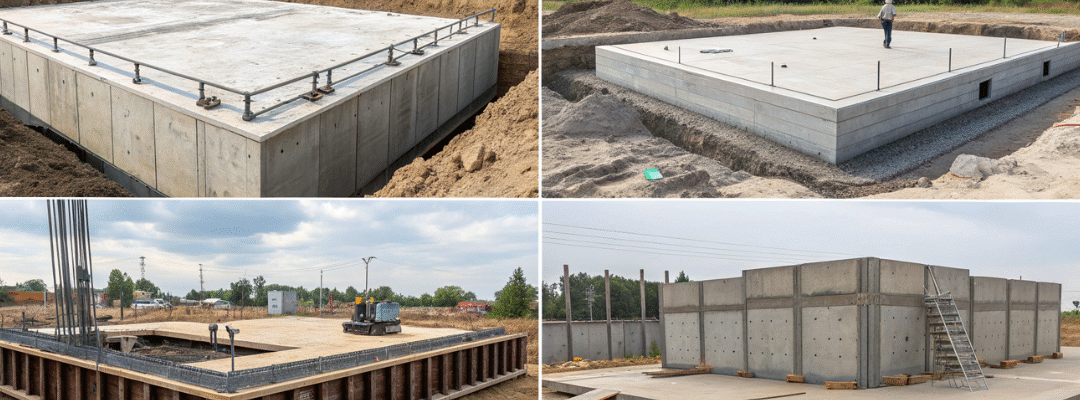
Why Foundation Type Matters
The foundation is the most critical part of any structure—it supports the entire weight of the building and ensures its stability for decades. Choosing the right type of foundation is essential for structural integrity, cost-efficiency, and long-term performance.
In this guide, we’ll explore the different types of foundations in construction, when to use each, and what factors influence the choice.
What Is a Foundation in Construction?
A foundation is the lowest load-bearing part of a building that transfers structural loads safely to the soil beneath. It distributes the weight of the building evenly and prevents settlement, tilting, or collapse.
Main Categories of Foundations
Foundations are broadly classified into two types:
- Shallow Foundations
- Deep Foundations
1. Shallow Foundations
Shallow foundations transfer building loads to the earth at a depth of less than 3 meters. They are ideal when strong soil is present near the surface.
Common Types of Shallow Foundations:
A. Isolated (Pad) Footing
- Use: Individual columns or piers
- Shape: Square, rectangular, or circular
- Best for: Light structures on firm soil
B. Combined Footing
- Use: Two or more columns too close together for isolated footings
- Best for: Property line constraints
C. Strip Footing
- Use: Load-bearing walls
- Best for: Residential houses and small commercial buildings
D. Raft (Mat) Foundation
- Use: Covers the entire building footprint
- Best for: Poor soils, basements, and heavy load-bearing structures
E. Slab-on-Grade
- Use: Concrete slab poured directly on the ground
- Best for: Garages, low-rise homes, and warehouses in warm climates
2. Deep Foundations
Used when the surface soil lacks strength, deep foundations transfer loads to deeper, stronger strata—often beyond 3 meters deep.
Common Types of Deep Foundations:
A. Pile Foundation
- Types:
- Driven piles: Precast concrete, steel, or timber driven into the ground
- Bored piles: Cast in-situ using a drilled hole
- Best for: High-rise buildings, bridges, marine structures
B. Pier Foundation
- Similar to pile foundation but with larger diameter shafts
- Used in: Low-rise buildings or to repair existing footings
C. Caisson Foundation
- Large watertight retaining structures
- Used for: Underwater or bridge foundations
D. Well Foundation
- Open-well foundations used for bridge piers in rivers
Key Factors Affecting Foundation Choice
| Factor | Influence on Foundation Type |
|---|---|
| Soil Type & Bearing Capacity | Determines shallow vs. deep foundation |
| Water Table Level | High water tables require special waterproofing or deep piles |
| Load of the Structure | Heavy loads may require raft or pile foundations |
| Building Type & Usage | Industrial, residential, bridges—all have different needs |
| Budget & Timeline | Raft or shallow foundations may be more economical |
| Local Building Codes | Must be followed to ensure safety and compliance |
Comparison: Shallow vs Deep Foundations
| Feature | Shallow Foundation | Deep Foundation |
|---|---|---|
| Depth | < 3 meters | > 3 meters |
| Cost | Lower | Higher |
| Soil Requirement | Firm soil near surface | Weak topsoil, strong strata deep |
| Common Use | Homes, low-rise buildings | Skyscrapers, bridges, towers |
| Construction Time | Quicker | More time-consuming |
Real-World Applications
| Foundation Type | Used In |
|---|---|
| Raft Foundation | High-rise apartment blocks in weak soil |
| Pile Foundation | Coastal buildings, bridges |
| Strip Footing | Residential villas |
| Slab-on-Grade | Warehouses, garages |
FAQs
Q: Which is the best foundation for a house?
A: It depends on the soil condition and design load. For most homes on firm soil, strip or raft foundations are ideal.
Q: Can I change the foundation type after construction has started?
A: It’s not advisable. Foundation changes should be made only after consulting a structural engineer.
Q: How do I know if the soil is strong enough for a shallow foundation?
A: Conduct a soil bearing capacity test through a geotechnical engineer.